BCMAnnot
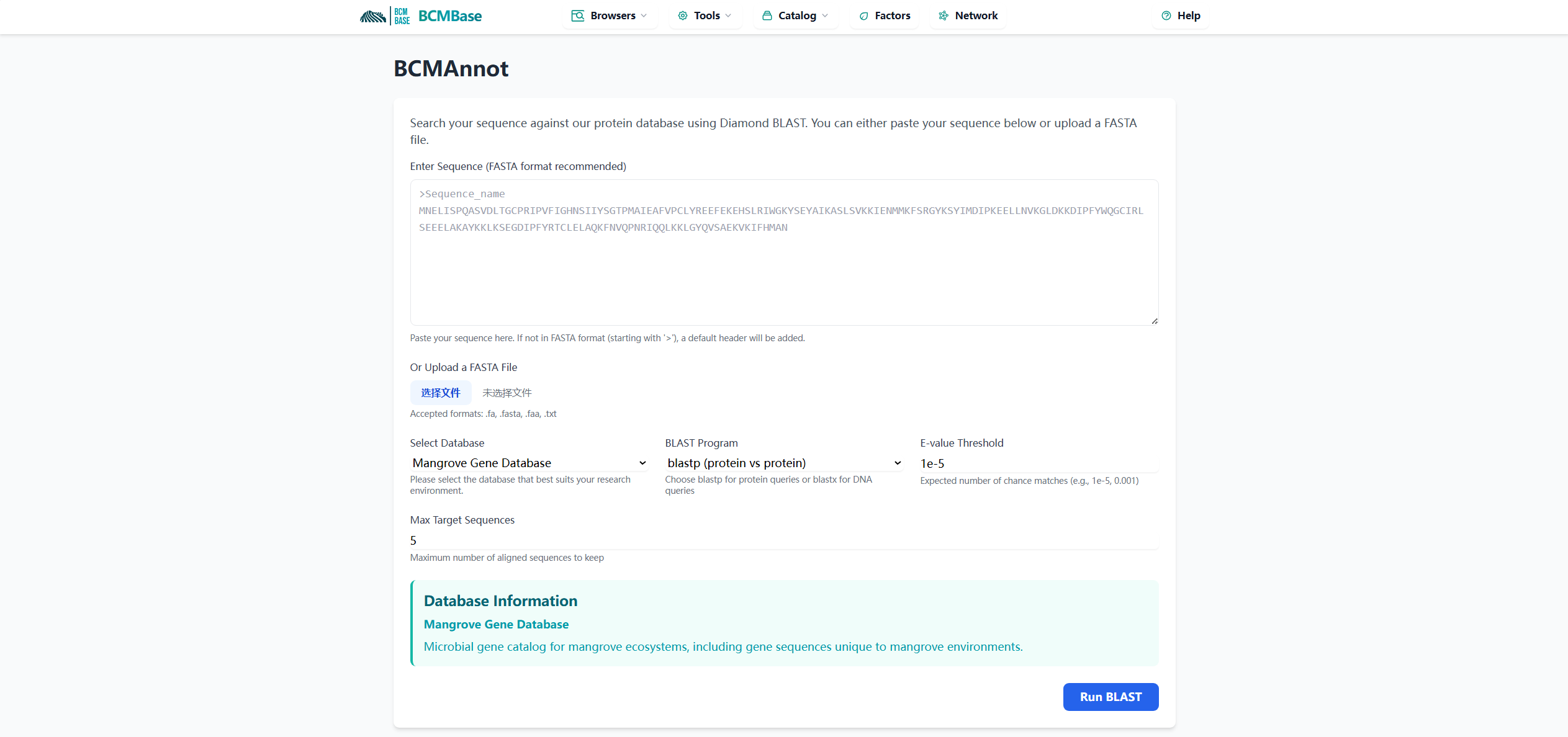
Search your sequence against our protein database using BCMAnnot. You can either paste your sequence below or upload a FASTA file.
Database Selection Guide
BMCBase offers three specialized gene databases; please choose the one that best suits your research environment:
🌿 Mangrove Gene Database (Mangrove Gene Database)
Suitable for research: Mangrove ecosystems, intertidal zones, and salt-tolerant plant rhizosphere microorganisms
Distinctive genes: Contains genes related to salt tolerance, antioxidant activity, and organic matter degradation unique to mangroves
Recommended use: Ideal for studies involving mangrove sediments, rhizosphere soils, and phyllosphere microbial communities
🌊 Saltmarsh Gene Database (Saltmarsh Gene Database)
Suitable for research: Salt marsh wetlands, high-salinity environments, and extremophile microorganisms
Distinctive genes: Rich in genes associated with extreme salt tolerance, osmotic regulation, and sulfur cycling
Recommended use: The top choice for researching salt lakes, salt marshes, and microorganisms in high-salinity seawater environments
🌱 Seagrass Gene Database (Seagrass Gene Database)
Suitable for research: Seagrass bed ecosystems, marine sediments, and marine plant microbiomes
Distinctive genes: Encompasses genes related to the seagrass rhizosphere, marine carbon and nitrogen cycles, and marine primary production
Recommended use: Recommended for studies of seagrass bed sediments and the rhizosphere of marine plants
Usage Instructions
- Select Database: Use the "Select Comparison Database" dropdown menu to choose the database that best suits your research environment
- Enter Sequence: Paste your sequence in the textbox or select a FASTA file using the "Upload File" option
- Set Parameters: Choose the BLAST program (blastp for protein sequences, blastx for DNA sequences)
- Adjust Thresholds: Modify the E-value threshold and maximum target sequence count as needed
- Run Search: Click "Run BLAST" to start the alignment; it usually takes 1-2 minutes
Features
Users can upload sequence files (e.g., .fa, .fasta, .faa, .txt formats) or directly enter sequence data to perform BLAST-based searches on the gene catalogs in the database, with the option to use either BLASTX or BLASTP mode.
- Supports multiple sequence input formats (FASTA, plain text)
- Offers three specialized ecological gene databases
- Automatically filters out low similarity results (<50% similarity)
- Supports exporting results in TSV format
- Displays search progress and parameter information in real-time
Tips
- Select the appropriate database: Choose the database corresponding to your sample's environment to significantly improve matching accuracy
- Sequence Length: It is recommended to use sequences longer than 50 amino acids or 150 nucleotides for the search
- E-value Settings: For conserved sequences, use a stricter threshold (1e-10), and for novel sequences, relax it to 1e-3
- Interpreting Results: Prioritize results with over 70% similarity, as these typically have higher functional relevance